As usual, we have omitted the August 2025 work report because most of our readers are taking their well-deserved annual vacation during this period, pursuing other interests and not finding the time to read our articles.
You have probably already heard in the international press that Mindanao has been hit by a severe earthquake. The epicenter is not far from our reforestation areas in Baganga, more precisely in Manay. As of October 10, 2025, we have therefore suspended all plantings in Mati and Baganga because the expected aftershocks also posed the risk of a tsunami hitting the coastline. Fortunately, we were spared a tsunami.
Since the Philippines are located close to the “Ring of Fire,” earthquakes are not unusual. The Ring of Fire is home to an estimated 450 to 915 active or dormant volcanoes. The exact number varies depending on the criteria used, for example, whether all underwater volcanoes are included. The Pacific Ring of Fire frames the Pacific Ocean on three sides. It stretches over 40,000 kilometers along the west coast of South, Central, and North America to the Aleutian Trench, via Kamchatka, Japan, the Philippines, Indonesia, and New Zealand. This volcanic belt is home to about 75 percent of the world’s active volcanoes, which cause about 90 percent of the world’s earthquakes because the Philippine Plate is being pushed under the Eurasian Plate. This enormous friction and pressure from the colliding plates leads to tensions that are released in the form of earthquakes.
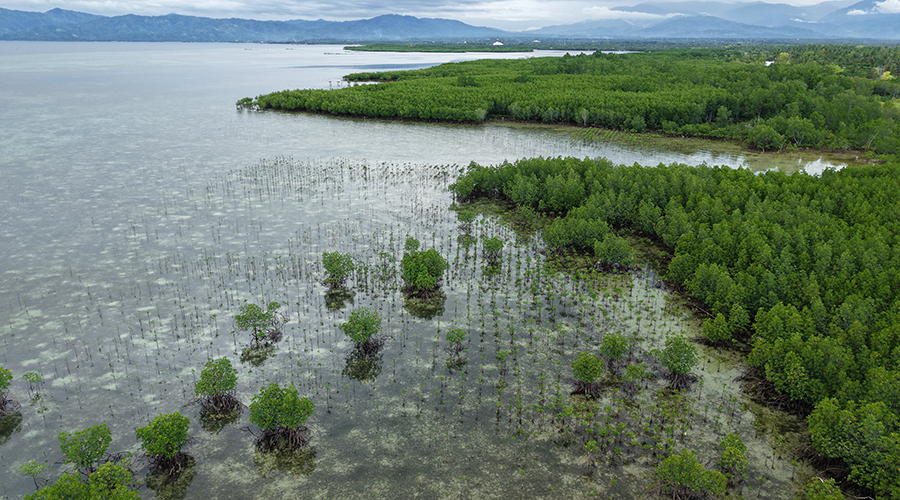


The situation in Baganga is as follows: According to the Philippine Department of Environment and Natural Resources (DENR), after our planting efforts (as of October 2025), there is a shortage of approximately 1.5 million mangroves in the southern part and approximately 7 million in the northern part. So there is still plenty of work to be done. Why not get involved, perhaps even with a mangrove subscription? Here is the link: https://mama-earth.eco/donate-mangroves/
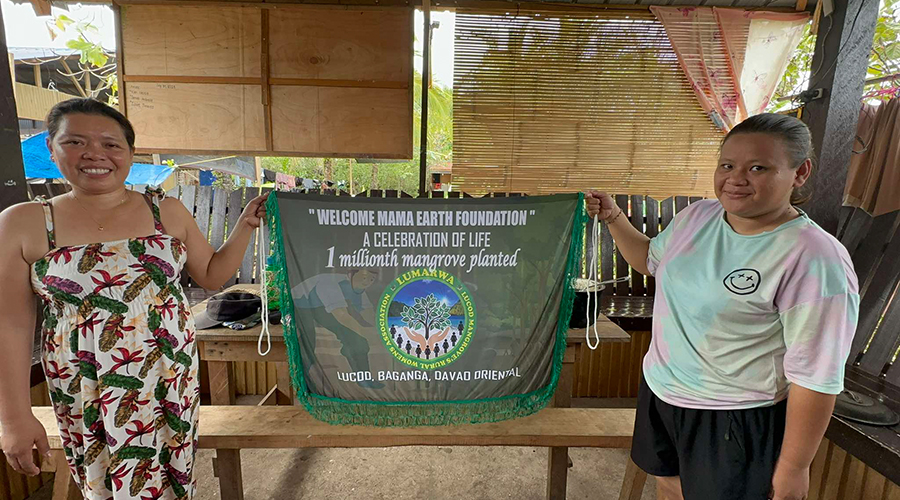
Due to the earthquake and various weaker aftershocks, our mangrove event had to be postponed because all government agencies are busy investigating whether public buildings are safe and people can return to work. This was a great disappointment for everyone because the preparations had been completed. Our achievement is remarkable: in less than a year, we have planted more than a million mangroves in Baganga. We did this with great care and in areas that are sometimes highly sensitive. We have special permission from the Protected Area Management Board (PAMB) to do this. Just to remind you: the Mama Earth Foundation has now planted over 5 million mangroves. But we don’t want to rest on our laurels and are already aiming for 10 million.
Even though we didn’t send out a work report, we weren’t just lying around in hammocks. Our small team was quite busy with our new website. We have been working on the new website for months. As always, the implementation was carried out by Videmi GmbH & CO. KG in 42281 Wuppertal, Germany. The site is already online. There are certainly still a few kinks that we will gradually correct. Currently, the new site is only available in English, as we are still working on the German version.
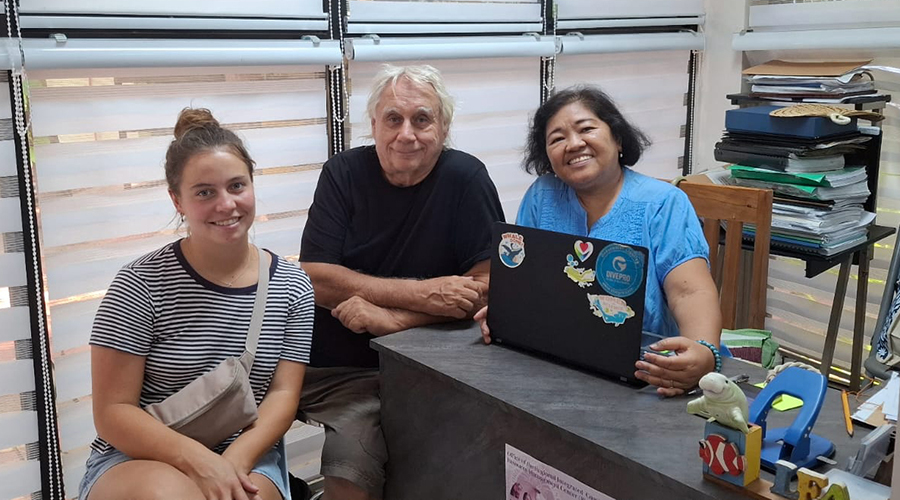
From left: Chiara, Uli, and Lea.


In the meantime, we have moved our small boat to Baganga, because that is where our main activities take place. Since it looked pretty worn after five years of mangrove work, we have arranged for a general refit. It will shine in new splendor in November and, since it will also be our decorative photo boat, it will bear the Mama Earth logo on the bow section.
The drone flights should now be complete. As reported, the drone takes a photo every second, which is automatically numbered to make it unique. The program for displaying the images has already been written. Christian is still working on the consolidation and the “glider,” a timeline that shows how the mangroves we planted are developing over the years. Now our foresters have to fly over the many planting areas and draw up a schedule for repeating the flights in order to obtain complete documentation. However, the difficult part is finally behind us. It took a lot of working hours, but we are impressed by what has been achieved so far. The many hours of work have paid off and the documentation will ensure even greater transparency in our work.
As is well known, we financed the expansion of the facility for the turtle conservation group “Amihan Brothers” in order to safely store the turtle eggs that are dug up almost every night and protect them from birds, dogs, cats, and even humans. Now we have launched a new campaign together at Dahican Beach in Mati, which we hope will be a success. The aim is to prevent microplastics by increasing the collection of plastic. For example, anyone who brings two kilograms of plastic waste from the beach to the collection point will receive a shell bracelet or a bamboo straw. Anyone who collects more than five kilograms will receive a T-shirt and a souvenir. More on this in the next newsletter.